
Distillation
Column, vacuum, batch, atmospheric and short-path distillation.
Pillars 01–04 · Materials Platform
Semiconductor precursors and electronic-grade chemicals, photoresist and functional monomers, OLED and organic-electronic intermediates, and specialty polymers — synthesised, purified and analytically released on one integrated platform.
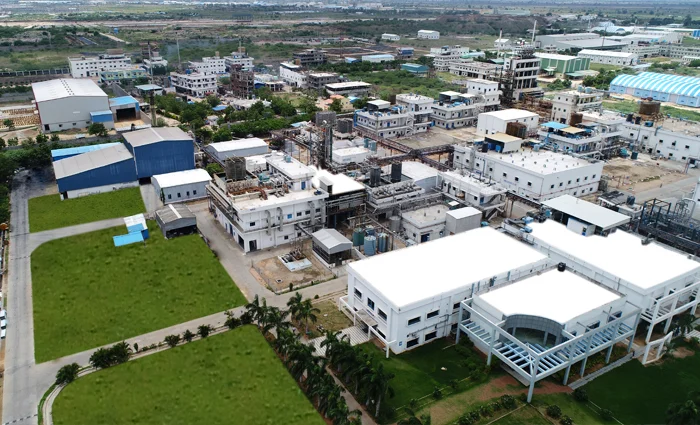
Stainless-steel and glass-lined reactor trains across Unit-I and Unit-II at Raichur and the Kadechur unit, supported by a dedicated 90-member electronic-materials R&D team.
| Site | Installed volume | Notes |
|---|---|---|
| Unit-I — Raichur | 304 KL | Specialty, semiconductor-grade & electronic-grade chemicals, OLED, imaging, polymers |
| Unit-II — Raichur | 393 KL | Manufacturing + co-located electronic, semiconductor, OLED, imaging & polymer R&D |
| Unit-III — Kadechur | 165 KL | High-volume scale-up block for monomer & specialty-chemical manufacturing |
| Total | 862 KL |
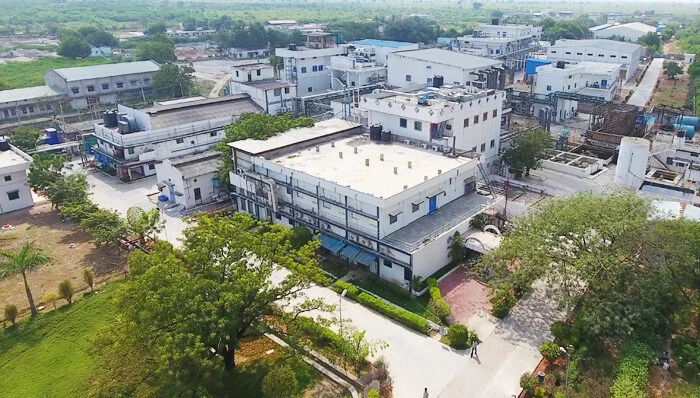
Column, vacuum, batch, atmospheric and short-path distillation.
Agitated, pressure and open Nutsche filters; centrifuge and peeler centrifuge.
3,000 L C-22+SS316 and 2,500 L SS316 cryogenic reactors, to −80 °C.
Hydrogenator, pressure rating 4.0–20.0 kg/cm².
The complete electronic and semiconductor chemicals offering, organised in the eleven categories used in our published product list. Every entry carries its CAS number so it can be matched directly against your bill of materials. Specification sheets and certificates of analysis are released under NDA.
Showing all 98 products
| Chemical / product name | CAS No. | Electronic / semiconductor application |
|---|---|---|
| 2-Vinylphenol | 695-84-1 | Electronic polymer and photoresist polymer synthesis |
| 3-Vinylphenol (3-Ethenylphenol) | 620-18-8 | Chemically amplified photoresists (CAR) |
| 4-Vinylphenol (p-Hydroxystyrene) | 2628-17-3 | Photoresist polymers and dielectric materials |
| 4,4',4'',4'''-(Propane-2,2-diylbis(cyclohexane-4,1,1-triyl))tetrakis(2-methylphenol) | 53091-59-1 | Photoresist resin and advanced polymer intermediate |
| p-Chloromethylstyrene (p-CMS) | 1592-20-7 | Photoresist resins and functional polymers |
| m-Chloromethylstyrene (m-CMS) | 39833-65-3 | Electronic coatings and crosslinkers |
| Vinylbenzyl Chloride (CMS Mixture) | 30030-25-2 | Photoresist and specialty polymer intermediate |
| o-Chloromethylstyrene (o-CMS) / 2-Chloromethylstyrene | 22570-84-9 | Advanced electronic polymer synthesis |
| 3-Isopropenylphenol | 51985-06-9 | Functional phenolic monomer used as a building block |
| 4-Iodostyrene (p-Iodostyrene, PIS) | 2351-50-0 | Functional monomers and photoresist building blocks |
| 2,4,6-Trimethylstyrene | 769-25-5 | Specialty electronic polymers |
| 4-Cyanobiphenyl 4-(2-acryloyloxyethoxy)benzoate | 133945-18-3 | Functional monomers and advanced electronic materials (or liquid crystal and display materials) |
| Chemical / product name | CAS No. | Electronic / semiconductor application |
|---|---|---|
| Pentacene | 135-48-8 | Organic field-effect transistors (OFETs) |
| Anthracene | 120-12-7 | Organic semiconductor crystals and electronic materials |
| Rubrene | 517-51-1 | High-mobility organic semiconductor |
| 2,2':5',2''-Terthiophene | 1081-34-1 | OFET and organic photovoltaic (OPV) materials |
| Dithieno[3,2-b:2',3'-d]thiophene | 3593-75-7 | Organic transistors and OPV |
| 3-Bromofluoranthene | 13438-50-1 | Organic semiconductor synthesis |
| Benzo[1,2-b:4,5-b']dithiophene-4,8-dione | 32281-36-0 | Donor polymer synthesis |
| 4,7-Dibromo-2,1,3-benzothiadiazole | 15155-41-6 | Organic photovoltaic polymer synthesis |
| 4,7-Di(thiophen-2-yl)benzo[c][1,2,5]thiadiazole | 165190-76-1 | Organic photovoltaic materials |
| 1,3-Dibromo-5-octyl-4H-thieno[3,4-c]pyrrole-4,6-dione | 566939-58-0 | Conjugated polymer synthesis |
| Dipyrazino[2,3-f:2',3'-h]quinoxaline-2,3,6,7,10,11-hexacarbonitrile (HAT-CN) | 105598-27-4 | OLED hole-injection layer (HIL) and charge-generation layer (CGL) material; strong electron-acceptor p-dopant |
| Chemical / product name | CAS No. | Electronic / semiconductor application |
|---|---|---|
| 1-Bromo-8-chlorodibenzo[b,d]furan | 2173554-83-9 | OLED emitter and host material intermediate |
| 1-Bromodibenzo[b,d]furan | 50548-45-3 | OLED material synthesis |
| 1-Bromo-3-chlorodibenzo[b,d]furan | 2043962-13-4 | OLED host/emitter material intermediate |
| 4-Bromo-2-chlorodibenzo[b,d]furan | 2087889-86-7 | OLED host/emitter material intermediate |
| 3-Bromo-1-chlorodibenzo[b,d]furan | 2409784-63-8 | OLED host/emitter material intermediate |
| 4,6-Dibromodibenzo[b,d]furan | 201138-91-2 | OLED host material synthesis |
| 4,4'-Dibromo-9,9'-spirobifluorene | 1257321-41-7 | OLED material synthesis |
| 2,2',7,7'-Tetrabromo-9,9'-spirobifluorene | 128055-74-3 | OLED host synthesis |
| 2,9-Dimethyl-4,7-diphenyl-1,10-phenanthroline (BCP) | 4733-39-5 | Electron transport layer (ETL) |
| 4,4'-Di(9H-carbazol-9-yl)-1,1'-biphenyl (CBP) | 58328-31-7 | OLED host material |
| 2,6-Bis(3-(9H-carbazol-9-yl)phenyl)pyridine | 1013405-24-7 | OLED host material |
| Tris(8-hydroxyquinolinato)aluminium (Alq3) | 2085-33-8 | OLED emitter and electron transport material |
| 4,4'-Bis(2,2-diphenylvinyl)biphenyl (DPVBi) | 142289-08-5 | Blue OLED emitter |
| Tris(4-bromophenyl)amine | 4316-58-9 | Hole transport material synthesis |
| 9,9'-Spirobifluorene | 159-66-0 | OLED host material synthesis |
| 9-(2-Bromophenyl)-9H-carbazole | 902518-11-0 | OLED hole transport material synthesis |
| 2,4,6-Triphenyl-1,3,5-triazine | 493-77-6 | OLED host material |
| 4-(3,5-Dibromophenyl)-2,6-diphenylpyrimidine | 607740-08-9 | OLED material synthesis |
| 1,4-Dihydroxy-2-naphthoic Acid (DHNA) | 31519-22-9 | Intermediate for OLED materials, organic semiconductors and electronic pigments |
| 1,4-Naphthionic Acid | 84-86-6 | Intermediate for electronic dyes, pigments and photoactive specialty chemicals |
| 3-(Benzo[d]thiazol-2-yl)-7-(diethylamino)-2H-chromen-2-one | 38215-36-0 | OLED and optical sensing |
| Chemical / product name | CAS No. | Electronic / semiconductor application |
|---|---|---|
| 2-(2-Bromophenyl)-4,6-diphenyl-1,3,5-triazine | 77989-15-2 | OLED host material synthesis (triazine intermediate) |
| 2-(3-Bromophenyl)-4,6-diphenyl-1,3,5-triazine | 864377-31-1 | OLED host material synthesis (triazine intermediate) |
| 2-(4'-Chloro-[1,1'-biphenyl]-4-yl)-4,6-diphenyl-1,3,5-triazine | 1443049-86-2 | OLED and display materials (triazine intermediate) |
| (6-Phenyldibenzo[b,d]furan-4-yl)boronic acid | 1010068-85-5 | Suzuki coupling for OLED synthesis (boronic acid intermediate) |
| 2,4-Diphenyl-6-(4-(4,4,5,5-tetramethyl-1,3,2-dioxaborolan-2-yl)phenyl)-1,3,5-triazine | 2088209-43-0 | OLED material synthesis (boronic ester intermediate) |
| Fluoranthen-3-ylboronic acid | 359012-63-8 | Organic electronic material synthesis (boronic acid intermediate) |
| Chemical / product name | CAS No. | Electronic / semiconductor application |
|---|---|---|
| 2,6-Bis(trimethylstannyl)-4,8-bis(5-(2-ethylhexyl)thiophen-2-yl)benzo[1,2-b:4,5-b']dithiophene (BDTT) | 1352642-37-5 | Distannylated BDT donor monomer for Stille-coupling synthesis of OPV donor polymers (e.g. PTB7, PM6, PBDB-T) |
| 4,7-Bis(5-bromo-4-(2-octyldodecyl)thiophen-2-yl)-5,6-difluorobenzo[c][1,2,5]thiadiazole (PCE11 Monomer) | 1504626-07-6 | Difluorobenzothiadiazole acceptor monomer for high-efficiency donor-acceptor OPV copolymers |
| 4,9-Dibromo-2,7-bis(2-hexyldecyl)benzo[lmn][3,8]phenanthroline-1,3,6,8(2H,7H)-tetraone (NDI-2HD-2Br) | 1459168-68-3 | Naphthalene diimide (NDI) building block for n-type polymer semiconductors used in OFETs and all-polymer solar cells |
| (4,4,9,9-Tetrakis(4-hexylphenyl)-4,9-dihydro-s-indaceno[1,2-b:5,6-b']dithiophene-2,7-diyl)bis(trimethylstannane) (IDTB6-2Sn) | 1252555-61-5 | Indacenodithiophene (IDT) distannyl monomer for low-bandgap donor polymers and non-fullerene acceptors via Stille coupling |
| 2,3,6,11,12-Pentakis(pentyloxy)-8-(4-(trifluoromethyl)phenyl)triphenyleno[1,2-d]oxazole (TpOx-Ph-p-CF3) | 2377209-48-6 | UV-excitable fluorescent discotic liquid crystal; donor-acceptor charge-transfer material for OLED and organic electronic applications |
| 8-Butyl-2,3,6,11,12-pentakis(pentyloxy)triphenyleno[1,2-d]oxazole (TpOx-n-Bu) | 2377209-24-8 | UV-excitable fluorescent discotic liquid crystal material for OLED/PLED and organic photonic applications |
| Y6 (BTP-4F) | 2304444-49-1 | A-DAD-A type fused-ring non-fullerene acceptor (NFA) for high-efficiency organic photovoltaics |
| N,N'-Dimethylperylene Diimide | 5521-31-3 | N-type organic semiconductor; perylene derivative |
| 5-Amino-3',6'-dihydroxy-3H-spiro[isobenzofuran-1,9'-xanthen]-3-one | 3326-34-9 | Electronic dyes and sensors |
| TCNQ (Tetracyanoquinodimethane) | 1518-16-7 | Electron acceptor and charge-transfer complexes |
| Quinacridone | 1047-16-1 | Organic electronics and photoconductors |
| 8,9,10,11-Tetrachloro-12H-isoindolo[2,1-a]perimidin-12-one | 20749-68-2 | Electronic pigments and optoelectronics |
| Chemical / product name | CAS No. | Electronic / semiconductor application |
|---|---|---|
| Diazonaphthoquinone (DNQ) | 879-15-2 | Photoactive compound for positive photoresists |
| Lithium Phenyl(2,4,6-trimethylbenzoyl)phosphinate (LAP) | 85073-19-4 | Water-soluble Type I photoinitiator for UV/visible-light polymerization, photoresists and 3D lithography |
| Sodium 3-Nitrobenzenesulfonate | 127-68-4 | Photoresist additive / resist formulation |
| Phenolphthalein | 77-09-8 | Photoresist formulations |
| N-Methyl-2-pyrrolidone (NMP) | 872-50-4 | Photoresist stripping and process cleaning |
| Dimethyl Sulfoxide (DMSO) | 67-68-5 | Photoresist stripping and cleaning |
| Propylene Glycol Monomethyl Ether Acetate (PGMEA) | 108-65-6 | Photoresist solvent |
| Hexamethyldisilazane (HMDS) | 999-97-3 | Photoresist adhesion promotion on silicon wafers |
| [2-(3,6-Dimethyl-9H-carbazol-9-yl)ethyl]phosphonic acid (Me-2PACz) | 2996161-30-7 | Self-assembled monolayer: hole-selective SAM for inverted (p-i-n) perovskite and perovskite/silicon tandem solar cells |
| [4-(3,6-Dimethyl-9H-carbazol-9-yl)butyl]phosphonic acid (Me-4PACz) | 2747959-96-0 | Application not stated in source list |
| Sodium Tetraphenylborate (STB) | 143-66-8 | Photoresist formulation, ion-pairing/electrolyte additive and catalyst precursor |
| Chemical / product name | CAS No. | Electronic / semiconductor application |
|---|---|---|
| Sodium Pentafluorobenzenesulfonate | 120193-44-4 | Fluorinated photoresists and specialty electronic materials |
| 2,3,4,5,6-Pentafluorostyrene | 653-34-9 | Fluorinated styrenic monomer |
| Chemical / product name | CAS No. | Electronic / semiconductor application |
|---|---|---|
| Tris(dimethylamino)silane (TDMAS) | 15112-89-7 | Silicon precursor for ALD |
| Bis(ethylcyclopentadienyl)ruthenium(II) | 32992-96-4 | Ruthenium ALD/CVD and metal deposition |
| Tris(acetylacetonato)iron(III) | 14024-18-1 | Thin-film deposition and metal-organic precursor |
| Trimethylgallium (TMGa) | 1445-79-0 | GaAs and GaN semiconductor deposition |
| Chemical / product name | CAS No. | Electronic / semiconductor application |
|---|---|---|
| Hydrochloric Acid (HCl) | 7647-01-0 | Wafer cleaning and etching |
| Nitric Acid (HNO3) | 7697-37-2 | Removal of metallic and organic contaminants |
| Sulfuric Acid (H2SO4) | 7664-93-9 | Wafer cleaning and etching |
| Hydrofluoric Acid (HF) | 7664-39-3 | Silicon wafer and silicon oxide etching |
| Phosphoric Acid (H3PO4) | 7664-38-2 | Cleaning and etching |
| Acetic Acid | 64-19-7 | Cleaning and wet-process applications |
| Citric Acid | 77-92-9 | Mild cleaning and etching applications |
| Phenol | 108-95-2 | Specialty electronic chemical and resin applications |
| Potassium Hydroxide (KOH) | 1310-58-3 | Wet etching, particularly MEMS fabrication |
| Potassium Carbonate (K2CO3) | 584-08-7 | Cleaning and process applications |
| Ammonium Hydroxide (NH4OH) | 1336-21-6 | RCA wafer cleaning and wet processing |
| Tetramethylammonium Hydroxide (TMAH) | 75-59-2 | Photoresist developer and silicon etchant |
| Hydrogen Peroxide (H2O2) | 7722-84-1 | Wafer cleaning and wet processing |
Supplied to SEMI Grade 1–5 (EL / UP / UPS / UPSS) against a ppt–ppb metals specification.
| Chemical / product name | CAS No. | Electronic / semiconductor application |
|---|---|---|
| Isopropyl Alcohol (IPA) | 67-63-0 | Semiconductor wafer cleaning and drying |
| Methanol (MeOH) | 67-56-1 | Cleaning and process solvent |
| Chemical / product name | CAS No. | Electronic / semiconductor application |
|---|---|---|
| Poly(hydroxystyrene) (PHS) | 24979-70-2 | Photoresist polymer |
| Poly(3-hexylthiophene-2,5-diyl) (P3HT) | 104934-50-1 | Conductive polymer / OPV material |
| Poly(9-vinylcarbazole) (PVK) | 25067-59-8 | OLED polymer / hole transport polymer |
| Poly(9,9-dioctylfluorene) (PFO) | 123864-00-6 | Light-emitting polymer |
Photosensitive polyimides, directed self-assembly block copolymers, photoresist base resins and optoelectronic conjugated polymers — with polymerization and functionalization developed in-house and scaled through qualification.
| Application area | Polymer class | Representative examples |
|---|---|---|
| Semiconductor — front-end | Photosensitive Polyimides (PSPI) | Functionalized polyimides for lithographic patterning |
| Semiconductor — front-end | Directed Self-Assembly (DSA) | PS-b-PMMA, PS-b-PDMS, PS-b-PEO block copolymers |
| Semiconductor — front-end | Photoresist Base Resins | Poly(hydroxystyrene) (PHS) for chemically amplified resists |
| Semiconductor — back-end | Non-Photosensitive Polyimides | Polypyromellitimide for device encapsulation |
| Semiconductor — back-end | Epoxy Polymers | Base epoxy resins for back-end-of-line packaging |
| Display & optoelectronics | Conductive / Photoactive Polymers | P3HT, PVK, PFO & donor–acceptor copolymers |
Anionic & cationic, free-radical/ATRP, ring-opening (ROP) and coordination polymerization. Catalysts: n-BuLi, borates, Ziegler–Natta.
ATRP, RAFT and living anionic/cationic routes for precise molecular weight and narrow PDI. Cu-ATRP and RAFT agents.
Polycondensation and polyaddition; interfacial and melt-phase step-growth. Redox / persulphate initiation.
Emulsion, suspension and mini-emulsion polymerization for controlled particle morphology.
Hydroxyl (–OH): telechelic and multifunctional OH-bearing polymers, adhesion promoters. Acrylate/methacrylate: UV/EB-curable systems, diluents and stabilizers. Carboxylic acid: direct –COOH installation via CO2 and ion-exchange chemistry.
Amine, epoxy and thiol click-chemistry and crosslinkable end-groups engineered for downstream device integration — installed by functional initiator at chain start or by post-polymerization transformation.
Reaction chemistries developed for OLED, imaging, photoresist and semiconductor-precursor materials, executed under inert atmosphere with glove-box control at O2 and H2O below 1 ppm.
Core scaffold for OLED hosts. Ring construction by Cadogan cyclization; N- and ring-functionalization via Buchwald amination, Ullmann and Suzuki coupling.
Hole-transport materials and OLED hosts. C–N bond formation via Buchwald–Hartwig, Ullmann and Chan–Lam coupling; aryl extension by Suzuki coupling.
Rigid, high-triplet-energy architectures for OLED, imaging and perovskite solar materials, via double Friedel–Crafts and intramolecular cyclization.
Suzuki–Miyaura building blocks via Pd-catalyzed Miyaura borylation, lithiation–boronation and iridium-catalyzed C–H borylation.
Grignard, organolithium, Negishi and Stille reagents under inert atmosphere — Schlenk lines and glove box at O2 & H2O <1 ppm.
Dess–Martin, Swern and TEMPO oxidation; catalytic hydrogenation (Pd/C, Raney Ni) and selective hydride reductions (DIBAL-H, LAH, Red-Al).
Williamson ether synthesis, Mitsunobu and Sandmeyer reactions, Vilsmeier–Haack formylation, Kolbe–Schmitt carboxylation.
Organometallic and metal-organic precursors for CVD and ALD deposition; sublimation and resin-based purification to device-grade purity.
Purity governs device yield. Every process step is engineered to remove a specific impurity class — metals at ppb, anions, organics, moisture and particles — and each is verified analytically before release.
Trace-level analytical release is built into every batch, from ppb metals through to molecular-weight distribution and viscoelastic behaviour.
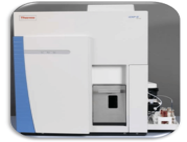
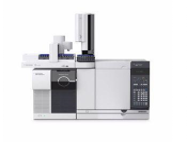
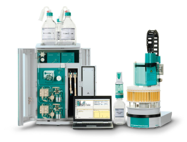
| Instrument | Make / model | Application |
|---|---|---|
| ICP-MS/MS | Agilent 8900 / Thermo iCAP RQ | Trace metals, ppb–ppt (~30 elements) |
| ICP-OES | Perkin Elmer Optima 8000 | Metals quantification |
| LC-MS/MS | Sciex 4500 / Thermo / Sciex 3200 QTRAP | Mass ID & impurity quantification |
| GC-MS/MS | Agilent 7010B / Thermo | Volatile impurities, residual solvents, monomers |
| GPC | Agilent 1260 Infinity GPC/SEC MDS | Molecular weight & purity |
| DSC / TGA | Perkin Elmer DSC 8000 / Pyris1 | Thermal transitions & stability |
| SEM | Tescan VEGA3 | Microstructural characterization |
| Ion Chromatography | Metrohm | Chlorides, sulfates, nitrates, phosphates, ammonium at ppm |
| Potentiometry / UV-Vis | Metrohm 905 Titrando / Shimadzu | Assay; non-chromophore compounds by CAD & RI detectors |
| Viscometer / Rheometer | Brookfield / Netzsch Kinexus | Dynamic & kinematic viscosity; viscoelastic evaluation |
Also performed: chromatographic purity to 99.99% by HPLC/GC, isomer analysis by HPLC/GC, unknown identification by LC-MS/GC-MS, colour by APHA method, and coulometric moisture analysis to electronic-grade specification, supported by ISO/IEC 17025-aligned testing capabilities.
The published tables are representative. Full product lists, specification sheets and certificates of analysis are released under NDA — send us the CAS number, purity target and volume and we will come back with a feasibility position.